


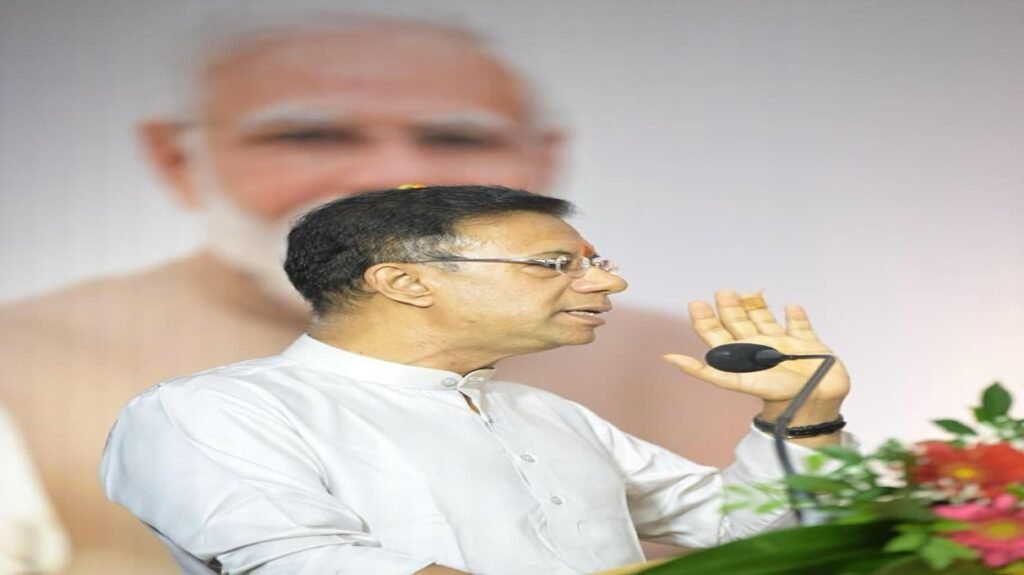
Inspired by the principle, “Sabka Saath, Sabka Vikas, Sabka Vishwas aur Sabka Prayas,” Vishwajit Rane has emphasized a development framework where Goa’s progress remains equitable, transparent, and focused on citizens. His approach places clear importance on strengthening public services, healthcare, infrastructure, and environmental sustainability, ensuring every community benefits from growth rather than only select regions or sectors.
The vision aligns with the nation’s larger goal of Viksit Bharat 2047, positioning Goa as a model state in governance, service delivery, and human development.
Inclusive Growth and People-Centric Governance
For a Viksit Goa, Rane stresses the need for development that reaches every household. The model focuses on efficient public services, stronger accountability, and timely delivery of welfare schemes. Instead of only showcasing large-scale projects, the plan emphasizes strengthening basic needs such as healthcare, clean water access, village infrastructure, and better connectivity in rural pockets.
Officials under the Health and Town & Country Planning departments are working on structured proposals to plug system gaps and ensure transparency in project approvals. According to the leadership perspective, a developed state cannot function without strong institutions, citizen trust, and clear rules of implementation.
Healthcare Strengthening as a Core Pillar
Healthcare continues to remain a priority area. Rane has pointed out that a modern state requires hospitals capable of handling public needs, trained professionals, specialized medical infrastructure, and fast digital patient services. The goal is to reduce dependency on private systems and make public hospitals robust and reliable.
The roadmap includes:
- Upgrading district and taluka hospitals
- Introducing specialised wings in government hospitals
- Faster availability of diagnostics and emergency services
- Increasing medical workforce capacity
- Long-term investments in public health technology
This framework supports the idea that an inclusive state must give equal and affordable healthcare access to every citizen, regardless of region or income.
Balanced Growth Beyond Urban Centres
While Goa is recognised for its urban pockets and tourism economy, the vision focuses on rural development and infrastructure that serve residents year-round. Roads, sewage systems, inland water management, village panchayat resources, and disaster planning are essential components of the governance approach.
Local-level services are being prioritised through:
- Better coordination between departments
- Use of technology to track complaints and approvals
- regular audits and field-level monitoring
The idea is to build a state where development benefits locals first, with transparent systems and reduced administrative hurdles.
Sustainable Development and Environmental Balance
Goa’s identity is closely linked to its environment—rivers, forests, coastlines, and biodiversity. The development model underlined by Rane acknowledges that infrastructure progress cannot come at the cost of ecological imbalance. Long-term sustainability measures include:
- Regulated construction and planning approvals
- Reinforced coastal protection to avoid erosion
- Monitoring of hill cutting and mining activities
- Preservation of agricultural and green zones
- Strengthening disaster response systems
This aligns with the global Sustainable Development Goals and ensures that future generations inherit a stable and livable environment.
Governance Built on Transparency and Accountability
A central point in this vision is that public development must be backed by clear rules, transparent processes, and strong oversight. Rane has repeatedly highlighted that policy decisions must follow lawful planning, technical scrutiny, and public consultation where necessary.
Departments are being directed to follow strict evaluation for approvals, and action is initiated where violations are found. This approach recognises that strong governance is not only about new projects, but also about correcting weaknesses, enforcing regulations, and delivering services efficiently.
The development roadmap presented by Vishwajit Rane reflects an approach that is structured, citizen-focused, and long-term in nature. It avoids short-term populism and instead lays emphasis on systems that will serve the public for decades. With better health infrastructure, rural and urban balance, environmental protection, and accountability in governance, the idea of a Viksit Goa becomes not just a slogan but an actionable framework.
The principle “Sabka Saath, Sabka Vikas, Sabka Vishwas aur Sabka Prayas” forms the backbone of this model, where progress includes every community, every family, and every individual.


