


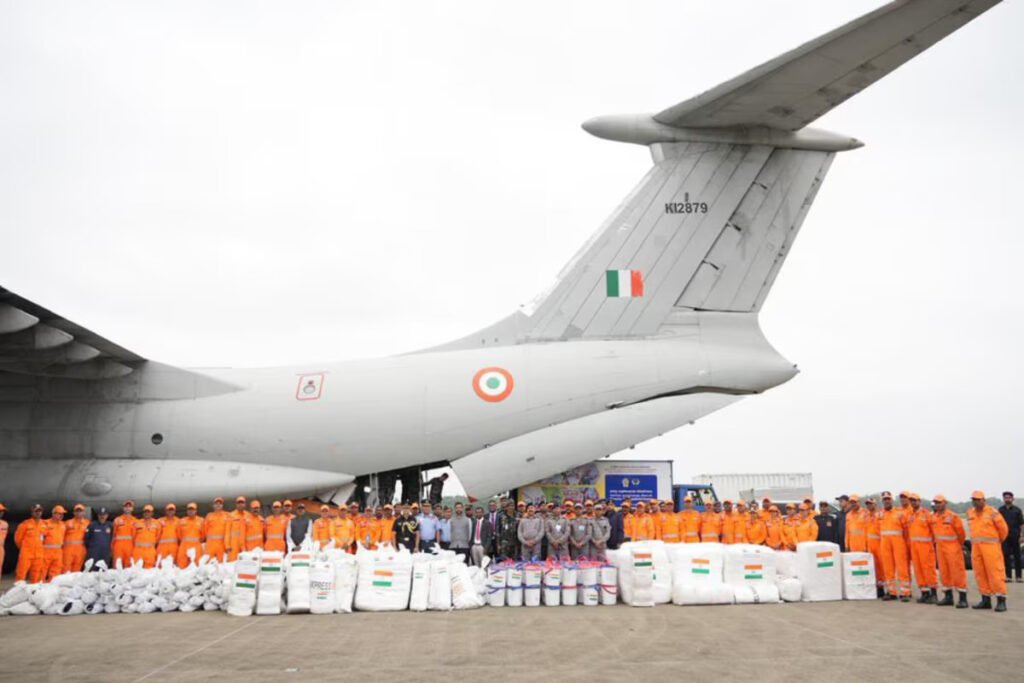
India has launched a comprehensive humanitarian relief operation named Operation Sagar Bandhu to assist Sri Lanka, which is currently battling the aftermath of Cyclone Ditwah, a devastating storm that struck the island nation late last month. The cyclone has resulted in severe destruction across all 25 districts, causing at least 410 deaths, nearly 336 people missing, and the displacement of more than 233,000 residents, according to official disaster management agencies. Thousands of families continue to struggle without food, shelter, healthcare access, or reliable infrastructure.
In response to the urgent humanitarian needs, the Government of India initiated the relief effort on November 28, marking one of the region’s largest disaster-response mobilizations in recent years. India’s assistance includes emergency food supplies, medical resources, evacuation support, and the deployment of specialized rescue personnel and field hospitals to restore critical services in the worst-affected regions.
Humanitarian Assistance Delivered Under Operation Sagar Bandhu
The first phase of the operation involved the transportation of 53 tons of ration supplies, including rice, pulses, milk powder, medicines, and hygiene kits, flown in by military aircraft and Indian Navy vessels. Additional emergency items such as temporary shelters, water purification units, and tarpaulin sheets have been distributed across relief camps to support displaced families.
Humanitarian officials reported that the mission’s earliest air evacuations included a cardiac patient requiring advanced medical attention and a pregnant woman who was shifted to safety following a complicated emergency. Medical support teams accompanied these early operations, offering immediate care and stabilizing dozens of wounded individuals across affected districts.
As flooding and landslides continue to block roads and disrupt supply chains, strategic airlifts are being used to reach isolated regions. Emergency response helicopters are conducting aerial assessments and transporting supplies to relief camps unreachable by road.
Deployment of Medical Teams, Field Hospitals, and Engineering Units
In the second phase of Operation Sagar Bandhu, Indian Army medical units, surgeons, paramedics, and rapid response teams have been stationed to establish mobile and semi-permanent field hospitals. These facilities will provide immediate trauma care, surgical support, and treatment for injuries caused by collapsed structures, landslides, and debris.
Alongside medical assistance, engineering teams have been deployed to help restore power lines, rebuild bridges, repair damaged infrastructure, and support the reopening of blocked transportation routes. Additionally, water-sanitation specialists are working to prevent the spread of water-borne infections that often escalate in post-disaster environments.
Officials emphasize that the mission is not limited to emergency short-term relief but includes a phased approach toward rehabilitation, infrastructure resumption, and long-term stabilization.
Strengthening Regional Partnership and Shared Responsibilities
India and Sri Lanka have maintained a long-standing diplomatic and cultural relationship, strengthened by cooperation during previous crises, including the COVID-19 pandemic and the 2004 Indian Ocean tsunami. Operation Sagar Bandhu builds on India’s wider SAGAR (Security and Growth for All in the Region) doctrine, which focuses on humanitarian outreach, maritime security, and regional solidarity.
Government representatives stated that the mission demonstrates India’s commitment to supporting neighboring countries during natural disasters and fostering a stable and resilient Indian Ocean region. Sri Lankan authorities expressed appreciation for the rapid deployment and extensive logistical coordination that enabled timely relief delivery.
International observers have described India’s leadership in disaster-assistance as a strategic humanitarian response, recognizing the broader regional benefits of a coordinated disaster-management framework.
Cyclone Ditwah’s Impact and Continuing Challenges
Cyclone Ditwah triggered catastrophic flooding, destructive winds, and widespread landslides, severely damaging thousands of homes, bridges, medical facilities, and agricultural fields. Communication networks remain partially disrupted, and multiple evacuation shelters continue to operate at full capacity.
Humanitarian agencies warn that food security, healthcare shortages, displaced family resettlement, and sanitation conditions are likely to pose continued challenges. Damage assessments are ongoing, and the scale of economic loss is expected to be substantial, particularly in agriculture and coastal fisheries.
Operation Sagar Bandhu aims to bridge the gap between immediate relief needs and long-term rebuilding while enabling Sri Lankan authorities to stabilize public services and infrastructure networks in the coming weeks.
Looking Ahead: Sustained Support and Recovery Planning
Indian officials have confirmed that relief support will continue in additional phases based on evolving ground assessment reports and coordination with Sri Lanka’s disaster management department. India has also indicated readiness to supply additional power support systems, medical equipment, and rehabilitation materials as required.
As efforts transition from rescue to recovery, international collaboration will likely be critical to restoring normalcy and rebuilding disaster-affected communities. Experts believe that India’s early intervention sets a positive example for future regional emergency coordination.
With global climate patterns increasing the frequency and intensity of storms in the Indian Ocean region, Operation Sagar Bandhu reinforces the need for strong partnerships, resilient infrastructure, and ongoing disaster readiness.


